
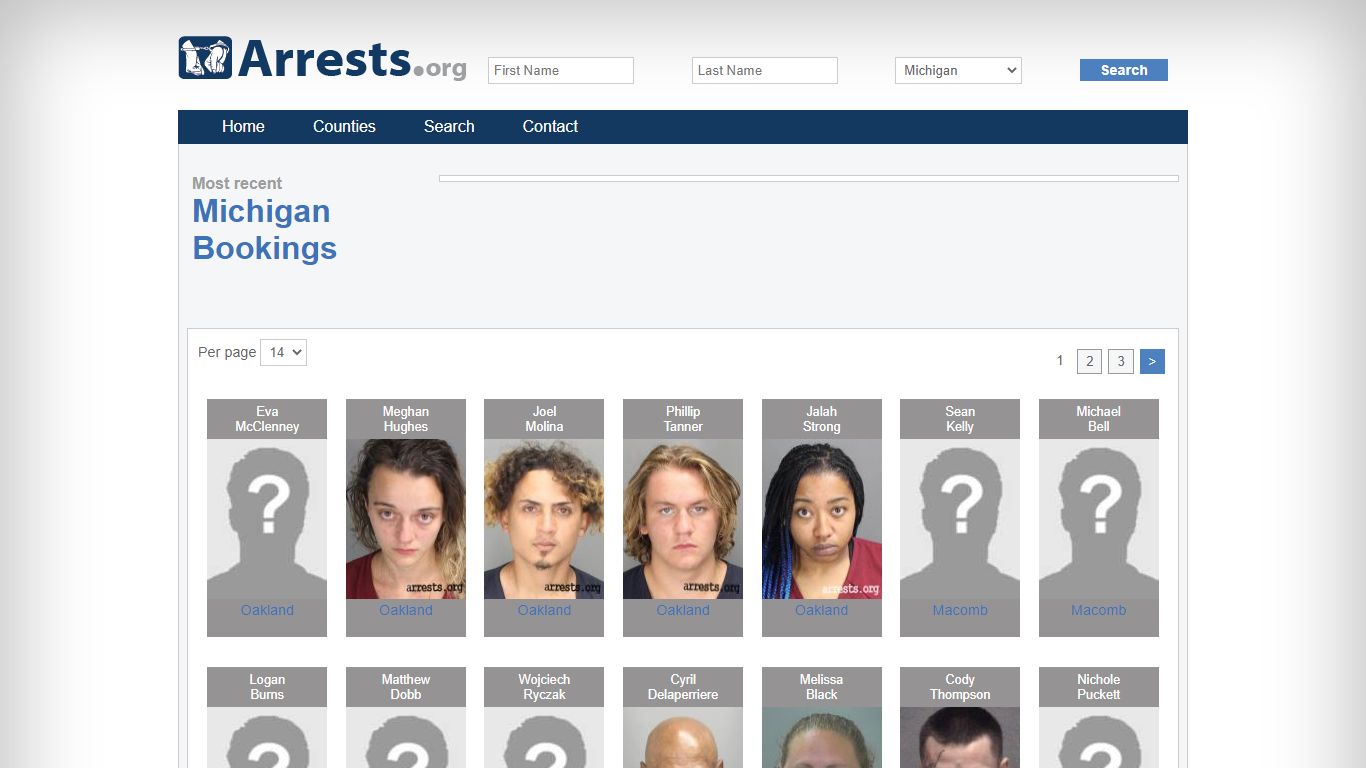
Arrests Org Michigan is a centralized public records platform that gives users direct access to the Michigan Department of Corrections online portal. This system contains more than 200,000 arrest records dating back to 2005, covering both misdemeanor and felony charges across all 83 counties. Each entry includes the exact Michigan Compiled Laws (MCL) charge code, arresting agency, booking date, bond amount, and a high-resolution mugshot. For instance, the August 2024 Muskegon County booking log shows Thomas Davis arrested on August 10 for obstruction of justice with a $10,000 bond, processed by the Muskegon County Sheriff’s Office. The database updates hourly and allows filtering by county, date range, or charge type, making it simple to locate specific incidents in major counties like Kent, Midland, or Macomb.
How Arrests Org Michigan Works
The platform pulls real-time data from county jails, sheriff’s offices, and municipal police departments across Michigan. When someone is arrested, their information is entered into the local booking system and synced to the statewide network within minutes. Arrests Org Michigan aggregates this data into a single searchable interface. Users can search by name, date, charge, or location. Every record displays the person’s full name, age, booking time, charge description with MCL code, bond amount, and a clear mugshot. Clicking “More Info” opens a detailed report that includes the police narrative, evidence list, and court schedule. The system is designed for transparency, allowing residents, employers, journalists, and legal professionals to verify arrest details quickly.
Understanding Michigan Arrest Warrants and Legal Procedures
In Michigan, not all arrests require a warrant. According to MCL 764.15, police can arrest someone without a warrant if they witness a misdemeanor or any felony. However, a judge-signed warrant is required in three specific cases: when the officer did not see the misdemeanor happen, when domestic violence is involved under MCL 750.3151, or when a DUI is suspected under MCL 257.625. The warrant must name the suspect (if known), describe the crime, cite the exact statute violated—such as MCL 750.434 for assault—and be signed by a circuit court judge. Once issued, it enters the Michigan Warrant Information System, which refreshes every 15 minutes and is available to all law enforcement agencies statewide.
The process from affidavit to warrant issuance typically takes 24 hours. Officers submit a sworn statement detailing probable cause. A judge reviews it and signs the warrant if the evidence supports it. Emergency warrants, such as those involving active threats or child endangerment, can be issued in under 10 minutes. These are marked as high priority and distributed immediately to patrol units. The system ensures accountability and prevents unlawful detentions by requiring judicial oversight for non-witnessed crimes.
County-Specific Arrest Data and Booking Logs
Each Michigan county maintains its own booking database, but Arrests Org Michigan consolidates them for easy access. Midland County, for example, recorded 215 bookings in August 2024—a 12% increase from July—with top charges including solicitation of a minor and conditional release violations. The daily log shows Philip Acre booked on August 9 at 7:47 a.m. and Nathaniel Sova at 3:01 a.m. the same day. Each entry includes bond amount, arresting officer, and a link to the full police report.
Kent County operates the largest mugshot repository in the state, with over 12,340 images from 2023 alone. Offenses range from petty theft (MCL 750.3411) to aggravated assault (MCL 750.4285). The system updates hourly and features a “Most Recent Bookings” sidebar showing the latest 25 arrests. Users can search by name, date, or charge code and view the arresting agency, bond amount, and arrest report PDF directly.
Macomb County logged 1,742 bookings in June 2024, with driving while impaired (MCL 257.625) and drug possession (MCL 750.152) as the most common charges. Each record includes a thumbnail mugshot, bond amount, and a “View Full Report” link. Muskegon County updates its database every hour, with July 2024 showing 1,318 bookings. Leading offenses included burglary (MCL 750.3121) and assault with intent to do bodily harm (MCL 750.4285). Clicking “Case Details” reveals the incident report, evidence, and court date.
Statewide Arrest Statistics and Trends
Michigan’s total arrests have remained relatively stable in recent years. The 2019 Crime Report documented 211,196 arrests—151,080 males and 60,116 females. By 2022, the number dropped slightly to 208,450, with 149,500 male and 58,950 female arrests. Fluctuations are linked to changes in opioid-related crimes and increased enforcement of motor vehicle fraud. StateRecords.org archives these annual reports and offers downloadable CSV files for researchers needing data by county, age group, or offense type.
The Michigan Offender Tracking Information System (OTIS) monitors individuals under supervision. As of October 2024, OTIS lists 12,500 active parolees and 22,300 probationers. Each record includes the offender’s name, offense, sentence length, supervising officer, and projected discharge date. Data updates every Friday night. Records are removed three years after supervision ends, per MCL 770.4. This ensures privacy while maintaining public safety transparency.
Court Records and Legal Documentation Access
Obtaining court records in Michigan is straightforward through three official channels. The Wayne County Clerk’s Office accepts written requests by mail, in-person visits Monday through Friday from 8 a.m. to 4 p.m., or online via the eCourt portal. Mailed requests take 5–7 business days. The eCourt system provides instant search results after identity verification using a driver’s license number. Certified copies cost $15 per document. The archive holds all Wayne County case files dating back to 1972.
Other counties follow similar procedures. Oakland County offers online docket searches through its court website. Ingham County allows email requests with photo ID. Most courts provide digital access to criminal, civil, and probate records. Some require a case number or party name. Fees vary by county but typically range from $5 to $20 per document. All systems comply with Michigan’s Freedom of Information Act (FOIA), ensuring public access to non-sealed records.
National Scope: How Arrests Org Compares Across States
Arrests Org operates nationwide, aggregating public arrest data from every U.S. county jail. As of 2024, the database holds over 10 million records. Users can filter by state (e.g., MI for Michigan), city, or charge code. Each entry shows the arresting agency, booking date, and mugshot when available. Updates occur nightly from state-run repositories, ensuring current information for counties like Wayne, Kent, and Macomb. This national reach makes it a valuable tool for background checks, journalism, and legal research.
Frequently Asked Questions About Arrests Org Michigan
Arrests Org Michigan serves as a vital resource for anyone needing access to public arrest records in Michigan. Whether you’re conducting a background check, verifying an individual’s legal history, or researching crime trends, this platform provides timely, accurate, and legally compliant data. Below are answers to the most common questions users have about how the system works, what information is available, and how to interpret the records you find.
How often is the Arrests Org Michigan database updated?
The Arrests Org Michigan database updates every hour, pulling fresh data directly from county jails, sheriff’s offices, and municipal police departments across the state. This ensures that users see the most recent bookings, including arrests made within the past 60 minutes. For example, if someone is arrested in Grand Rapids at 2:15 p.m., their name, charge, and mugshot typically appear on the site by 3:00 p.m. The Michigan Warrant Information System refreshes even faster—every 15 minutes—so active warrants are nearly real-time. This frequent updating supports law enforcement operations and helps the public stay informed about local safety issues. Unlike older systems that updated only once per day, Arrests Org Michigan’s infrastructure uses automated APIs to sync with official sources, minimizing delays and human error.
Can I find juvenile arrest records on Arrests Org Michigan?
No, Arrests Org Michigan does not display juvenile arrest records. Under Michigan law (MCL 712A.23), most juvenile records are sealed and not accessible to the public. Only certain serious offenses, such as murder or sexual assault, may be tried in adult court and become part of the public record. Even then, identifying details like full name and mugshot are often redacted or withheld. The platform only includes records for individuals aged 17 and older who were processed through adult criminal courts. If you need information about a minor’s legal status, you must contact the juvenile court directly or obtain a court order. This policy protects young people’s privacy and supports rehabilitation efforts.
Are mugshots on Arrests Org Michigan considered public record?
Yes, mugshots are public records in Michigan once someone is booked into jail. The state’s Freedom of Information Act (FOIA) treats booking photos as non-exempt information, meaning they can be accessed by anyone. Arrests Org Michigan legally obtains these images from county jails and displays them alongside arrest details. However, simply appearing in the database does not imply guilt—many charges are later dropped or reduced. Some states have passed “mugshot removal” laws, but Michigan has not. That said, individuals can request record expungement if charges are dismissed or they are acquitted. Once expunged, the record is removed from public databases, including Arrests Org Michigan, within 30 to 60 days.
How do I request a correction if my arrest record is inaccurate?
If you find an error in your arrest record on Arrests Org Michigan—such as a wrong charge, date, or name—you must contact the arresting agency or county clerk directly. The platform does not edit records; it only displays data provided by official sources. For example, if the Muskegon County Sheriff’s Office listed the wrong MCL code, you would need to file a correction request with their records division. Once the agency updates its system, Arrests Org Michigan will reflect the change during the next hourly sync. You may also submit a formal dispute through the Michigan State Police’s Criminal History Record Review process. This ensures accuracy and protects your rights under state law.
Can employers use Arrests Org Michigan for background checks?
Yes, employers can use Arrests Org Michigan as part of a background check, but they must follow federal and state laws. The Fair Credit Reporting Act (FCRA) requires consent from the job applicant before running any check. Additionally, Michigan’s Ban the Box law (Public Act 331 of 2023) prohibits employers from asking about arrests or convictions on initial job applications for most positions. If an arrest appears in the database, the employer cannot automatically disqualify the candidate—they must assess the nature of the charge, its relevance to the job, and whether it resulted in conviction. Arrests without conviction cannot be used to deny employment under EEOC guidelines. Always consult legal counsel before making hiring decisions based on arrest records.
What should I do if I find an active warrant for myself?
If you discover an active warrant through Arrests Org Michigan, do not ignore it. Contact a criminal defense attorney immediately. Turning yourself in without legal advice can lead to immediate arrest and missed opportunities to resolve the matter favorably. Your lawyer can verify the warrant’s validity, check for errors, and arrange a voluntary surrender if needed. Many warrants are for minor issues like missed court dates or unpaid fines, which can be resolved quickly. Delaying action may result in additional charges, higher bail, or a bench warrant with a “no bond” order. Remember, the Michigan Warrant Information System is used by all law enforcement agencies—avoiding police will not make the warrant disappear.
How long do arrest records stay on Arrests Org Michigan?
Arrest records remain on Arrests Org Michigan as long as they are maintained by the originating county or state agency. Most counties retain booking data indefinitely unless the record is expunged. In Michigan, you can apply for expungement if you were acquitted, charges were dismissed, or you completed a diversion program. Once granted, the court orders all agencies—including jails and databases—to seal or delete the record. Arrests Org Michigan removes expunged entries within 30 to 60 days of receiving the updated data. Felony convictions may be eligible for expungement after five years; misdemeanors after three. Always check your eligibility with the Michigan Department of Corrections or a legal aid organization.
For official inquiries, contact the Michigan Department of Corrections at (517) 335-1426. Visit their office Monday through Friday, 8 a.m. to 5 p.m., at 206 E. Michigan Ave, Lansing, MI 48913. The Offender Tracking Information System (OTIS) can be accessed online at https://www.michigan.gov/corrections/otis.